30 August 2026
Post-Visit Feedback Survey: Know How Customers Feel Before They Stop Coming Back
A one-chair barbershop in Klang. After every haircut, the owner asks "how's that, bro — good?" — and the answer he gets is almost always "yeah, fine". A customer who is actually unhappy with a messy fade line pays, smiles, and leaves anyway. He doesn't come back the next month, and the owner never finds out why — because a question asked while the customer is still sitting in the chair rarely gets an honest answer.
A car workshop in Ipoh. A major service costs RM380, the customer pays, takes the keys, and leaves without much comment. A week later he posts a two-star review on Facebook because the engine still makes a strange noise after the service — and the owner only finds out when another customer forwards a screenshot of it into the shop's WhatsApp group.
A home-based spa studio in Shah Alam, run solo. The owner tries sending a manual WhatsApp message — "how did that massage feel?" — after every session. On a busy day with six or seven clients back to back, she forgets to send it to half of them. When a fellow business owner asks "what's your average rating, actually?", she doesn't have an answer — only a feeling.
Why this keeps happening
First: a question asked face to face rarely gets an honest answer. A customer still standing at the counter, in front of the person who just served them, is not comfortable criticising directly. "Fine" is the safe answer, not necessarily the true one.
Second: an owner only hears about a problem once the customer has already decided what to do about it. Unspoken dissatisfaction doesn't disappear — it waits until the customer switches to another shop, or writes a public review. By then there is nothing left to fix for that particular visit.
Third: a manual follow-up depends entirely on the owner remembering to send it, for every customer, every day. It works fine on a quiet day. On the busy day — the day when knowing how a lot of customers feel at once matters most — that follow-up is exactly what gets skipped.
Fourth: the feedback that does arrive is scattered. Some in a private WhatsApp chat, some as a Facebook comment, some just sitting in a customer's head who never said anything at all. There is no single place to see the pattern — three customers this month mentioning the same problem, say, without the owner ever noticing because each complaint arrived separately.
What owners try instead
Most common: asking directly at checkout. Fast, no extra tools needed, but biased toward a positive answer, as in the barbershop story above.
Some try sending a manual WhatsApp message a few hours or a day after the service. This is a genuine, often effective effort — but it does not scale past a handful of customers a day, as the spa studio above found out.
Others rely on asking for a Google or Facebook review. This captures public opinion, but only from customers who feel either very happy or very unhappy — the average customer who'd rate a visit 3 out of 5 rarely bothers writing a public review. And once a review is live, it's already a public problem, not something that could have been resolved privately first.
The most passive version: waiting to hear it through word of mouth, like the workshop in Ipoh. By the time it reaches the owner, it has already become someone else's story, not information that could have been acted on at the time.
How a feedback survey should work
First principle: ask automatically once the booking is closed, not face to face. In TempahKu, when you mark a booking "Complete" and that customer has an email on file, the system sends a feedback email on its own — you don't have to remember to send anything. If the customer is a walk-in with no email, this email is skipped silently; it never blocks or slows down marking the booking "Complete" itself. The same mechanism also sends a survey — asking for a reason instead — when a booking is cancelled.
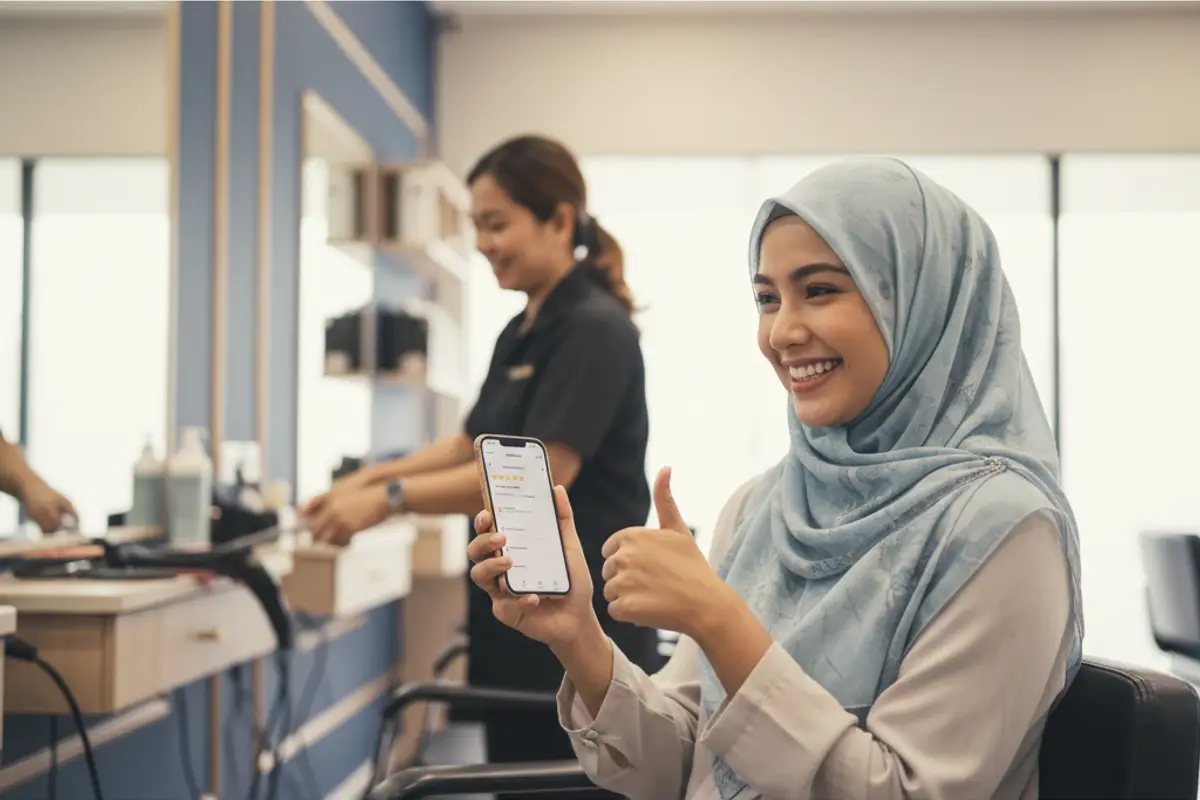
Second principle: the form has to be short and specific, not a questionnaire. The customer clicks the link in the email, sees five stars to tap and one optional comment box — "Any suggestions for us?" — not a long form. For a cancelled booking, it asks for a reason from five fixed options (a schedule change, a personal emergency, being unhappy with the service, forgetting to cancel earlier, or other), so the owner can see the real pattern behind cancellations instead of just knowing that they happened.
Third principle: every link is valid for ONE booking, and only once. Each email carries a unique code tied to that specific booking — nobody else can reuse the same link to leave feedback under someone else's booking, and the system stores exactly one feedback record per booking, so no single customer can resubmit the same form repeatedly to skew the average.
Fourth principle: every response has to live in one place, not scattered like before. The "Customer Feedback" page on the dashboard collects every response — its type (post-service or cancellation), the star rating, the cancellation reason where relevant, and any comment — in one list, with three numbers summarised at the top: average rating, total feedback, and percentage positive (4–5 stars). A feeling that used to be a guess — "seems like more people have been unhappy lately" — now has an actual number behind it.
When it helps most
It matters most for businesses where customers come back regularly but the owner doesn't have time for a long conversation with every one of them after every visit — salons, spas, beauty clinics, workshops with recurring servicing. This is exactly where a quiet decline in satisfaction is easiest to miss until it's too late, because nobody is asking consistently.
It also helps once more than one staff member serves the same recurring customers. Because every feedback record keeps the service name and booking date attached, an owner can scan back through entries to spot a pattern — several negative comments clustered around one particular service, for instance — even though the list itself doesn't automatically sort by staff member.
But honestly — if your business is small, almost every customer arrives on a friend's recommendation, and you already know every name, an automatic survey may feel like overkill for now; that closeness already gives you honest feedback without needing a system for it. It also only works for customers who gave an email when they booked — if most of your customers are walk-ins with no email, like the barbershop in the first story, this feature stays silent for them. It is not a replacement for asking directly; it's what happens in addition, whenever an email is on file.
In short
The real problem was never that owners don't want to know how customers feel — it's that they usually hear it last, or that the answer they get face to face is the polite one, not the honest one. TempahKu sends a feedback survey automatically once a booking is marked "Complete" or cancelled, using a code unique to that booking so it can only be rated once, and gathers every response into one dashboard with the average rating and percentage positive visible at a glance. It doesn't guarantee every customer will fill it in — but when they do, the answer reaches you before it becomes a public review, or before that customer quietly stops coming back.
